
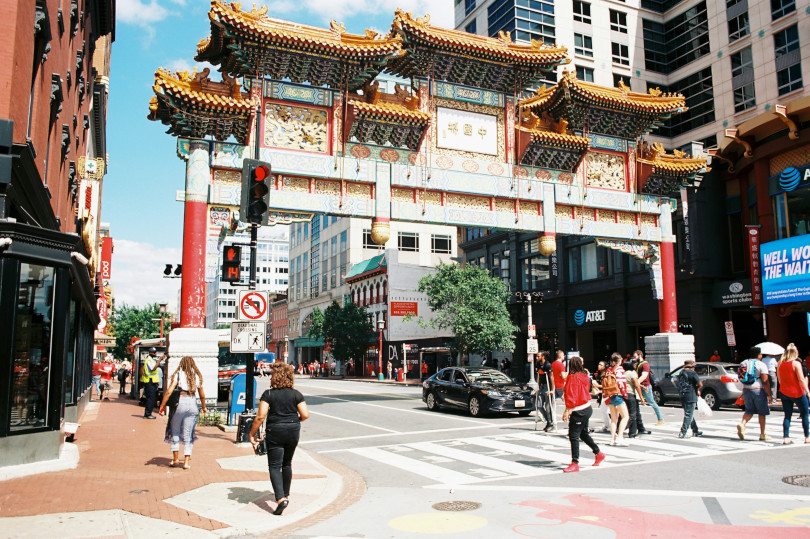
Among the neighborhoods in Washington DC, Chinatown is uniquely situated in Chinese American culture while also operating as the home of Washington sports teams and a bustling metro stop. Chinatown welcomes visitors with the iconic Friendship Archway on 7th and H Street. From summer concerts to the winter holiday market, the neighborhood is busy year-round as an entertainment, dining and tourism hub.
DC is preparing to update the rules that define what Chinatown looks like, from lettering on signs to the architectural designs on buildings. An ANC 2C meeting held on February 10 revealed that even a “technical update” can raise much deeper questions about authenticity and representation.
Stirring Debate
The city is now soliciting community input on how to proceed with preserving the identity of Chinatown as a neighborhood. Timothy Maher with the DC Office of Planning (DCOP) was present at the meeting to share proposed design changes with community members.
In describing the anticipated changes to the Chinatown design plan Maher said, “This is in part a technical update…we want to revise some of that language to clear up discussion.” Some of the proposed updates include fixing outdated references, incorrect imagery and tightening language that is confusing and repetitive.
This update is not just about rewriting city codes. It’s about better reflecting the culture of the neighborhood. “There are photographs in the current document that, embarrassingly, are of Japanese signage,” Maher said.
When the floor opened up for questions from community members, Tatenda Rameau asked “are we envisioning a Chinatown that includes multiple Asian cultures, or is it about having a true and authentic Chinese representation?” This raised the question of who the neighborhood is catering towards with its design.
Culture and Identity
Chinatown has become one of DC’s most symbolic cultural districts, with design rules dating back to the 1970s. These design rules were put in place to celebrate Chinese American identity in DC while welcoming a host of American businesses to operate in the area.
In 1976, the district introduced the “District’s Chinatown Program.” This program was created to “reinforce the distinctiveness of Chinatown.” In 1989 the “Chinatown Design Guidelines Study” set rules for buildings and streetscape design. This study was primarily focused on architects and developers in keeping up to date with design policies.
The 2009 “Chinatown Cultural Development Small Area Plan” focused on pursing quality of life goals and protecting Chinatown’s character further. In 2017, DCOP created a “Chinatown Design Guide Study.” Its focus was balancing innovation and creativity while maintaining the distinct culture and character of the neighborhood. Now, DCOP is revising this guide to better reflect the current neighborhood.
Over time with redevelopment and gentrification of Northwest DC, the neighborhood has lost much of its Chinese population. Guidelines from the DCOP have not always been culturally accurate, leading to frustration among community members.
The aesthetics of Chinatown can be marked as performative, focusing more on architecture than community. Since 2010 the demographic shift in Chinatown has left the neighborhood with approximately 300 Chinese American residents, according to the 2020 census report.
Restoring Authenticity
A commissioner of ANC 2C expressed concerns about the performativity of Chinatown’s design guidelines. “So often with the lettering and the naming in Chinatown, it just seems like I have to slap these letters on my sign and that makes it Chinatown.” This raises questions of how Chinatown can keep its cultural authenticity in a neighborhood that has been transformed over the years.
While the city has not come to any concrete ideas on how to properly redefine Chinatown, surveys are now open to residents. Focus groups like 1882 Foundation and Save Chinatown Network are dedicated to upholding cultural values in the neighborhood.
Chinatown remains a cultural district in Washington, but to what extent? Can a neighborhood’s authenticity be preserved even when the culture is no longer guaranteed by those who live there?
Featured image/photo by Gregory Elion on Unsplash.