
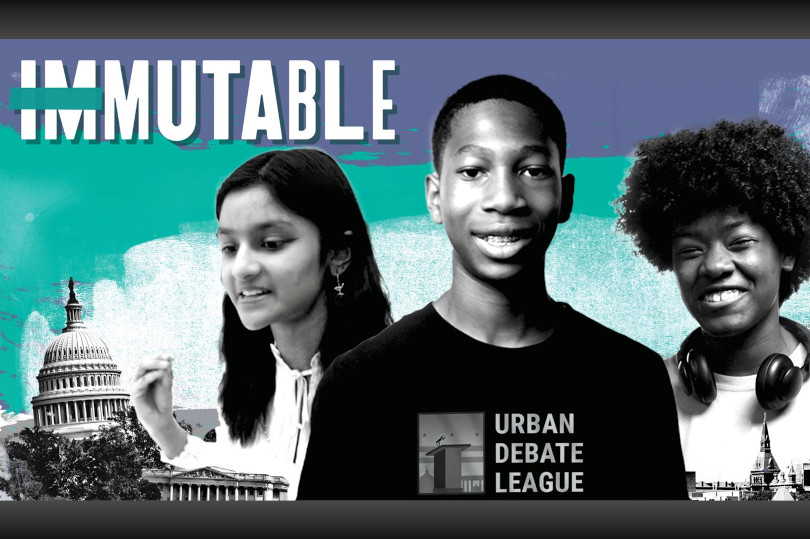
The Washington Urban Debate League is a DC youth program that is partnered with more than 75 schools across 3 school districts, providing students a space to get involved in debate, which, before it was founded in 2014, was primarily exclusive to private institutions.
From an objective perspective, expanding access to debate may seem like the program’s primary achievement. However, this barely scratches the surface of how transformative WUDL truly is to students in DC, and how essential its teachings are, especially in today’s polarizing political climate.
The film Immutable featured on PBS on March 6th further explores this transcending perspective of the Washington Urban Debate league, to truly get to know the program beyond what’s on the WUDL website or assumptions of a traditional school program, and how important it is to invest in youth.
I had the amazing opportunity to speak with directors and producers Charlie Sadoff and Gabriel London along with one of the students, Parker McCauley, to learn more about their perspectives with the program. Charlie and Gabriel as observers of the program worked closely with students at WUDL through two years of filming Immutable; Parker participated in the league throughout their high school experience.
Community and Expanding Opportunities
While competition is a central part of debate, WUDL is equally defined by its strong sense of community. Parker emphasized that students are not just participants, but leaders. As they gain experience, many take on mentorship roles, helping younger debaters develop their skills and confidence. Parker noted how seniors and graduate students will go on and take on a mentorship role with freshmen and new members.
They went on to say “WUDL is not like a football team where you will be competing against different schools, and when you see them its only about win or loss. When we’re at tournaments, we’re all so focused on improving our own arguments and learning from each other… if we didn’t try to talk to each other and form any form of relationship, we wouldn’t be able to bounce off each other’s ideas and understand each other’s arguments so that we can argue against them.” The emphasis of Communication in debate seems to be a guiding principle of bringing people together and forming these strong relationships.
Gabriel, another debater, described how this sense of community extends beyond high school: “Debaters will graduate, and come back as judges or mentors with younger debaters. There is a great spirit of community and giving back to each other, so many coaches were former debaters.” As a D.C. student myself, this stood out.
DC has a competitive, hustle culture, creating a fast-paced atmosphere where it can feel like everyone is on their own path and be isolating. WUDL provides a space where students can feel a sense of community and also uplift each other through mentorship, even in such a competitive activity like debate.
WUDL also opens doors for students in meaningful ways. Former WUDL student Liv Birnstad, who went on to win National Debater of the Year in 2023, is now a junior at Harvard University. Parker McCauley went to Howard after nationals their senior year, and both Liv and Parker are still involved.
WUDL creates this cyclical nature of community where students will graduate, new students will come in, and old students will come back as coaches and mentors.
“At every tournament, and every time we turned around, there was Liv because she was staying so involved, not just in the Urban Debate community in Boston, where she was, but also with Washington Urban Debate League,” says Gabriel.
Debate in a Polarized World
One of the most striking themes from my conversation with the filmmakers and Parker was how debate can serve as a response to today’s increasingly polarized political climate.
Gabriel described WUDL as an antidote to the division that defines much of today’s discourse:
“At this moment, everyone is focused on tribalism and hyper-partisanship. The film acts as an antidote to that—it shows something different. These students learn to make arguments from both sides and to see empathetically. There’s something really leveling about that, because it shows what’s possible when we create space for real conversations and engagement with each other.”
Parker echoed this: “So many topics we learn about in debate are things that schools won’t touch on. You learn both sides, and it expands your thinking because new things are happening all the time, especially with current events.”
That kind of deep engagement feels increasingly rare. Research has shown that average attention spans have shortened significantly in the digital age, and media outlets have responded by trimming articles and prioritizing quick takes over nuance. Literally and figuratively, people are losing the patience to read between the lines. Forming a well-rounded argument — the kind WUDL demands — requires dedication, research, and the willingness to genuinely understand a position you may not personally hold.
That stands in contrast to much of how political identity works today. Many organizations are built around shared beliefs, which is beneficial to advance specific causes. WUDL, however, is built around a shared passion for learning, not a belief system. Rather than rallying around a specific viewpoint, in WUDL, students win championship debates by defending sides they may agree or disagree with, requiring a well-rounded understanding of perspectives. This skill is invaluable to real-world politics. I believe the more educated you are, the less clear-cut your opinions are, because you are able to hold multiple truths at once.
Maturity, in many cases, means accepting that some questions don’t have a right answer — only perspectives worth understanding. Debate trains you to sit with that discomfort, and WUDL makes that training accessible to students who might never have had it otherwise
Immutable is a compelling and powerful film. As Charlie explained, “You don’t have to know about debate—or even be interested in it—to enjoy the film. Debate is part of it, but it’s much more than that. The film is about people—kids overcoming obstacles and being inspired.”
That sentiment holds true. While Immutable follows a youth debate program, it ultimately tells a much larger story: how to think critically, how to support one another, and how to be role models for a more understanding world.
#Immutable
#DCVoice
#TheDCVoice
#DCVoiceMedia
#DCVoiceNetwork
#DCVoiceTV
#DCVoiceStudios
#DCVoiceOfficial
#changingthenarrative
#media
#news
Featured image courtesy of immutablefilm.com.
Podcast: Play in new window | Download