

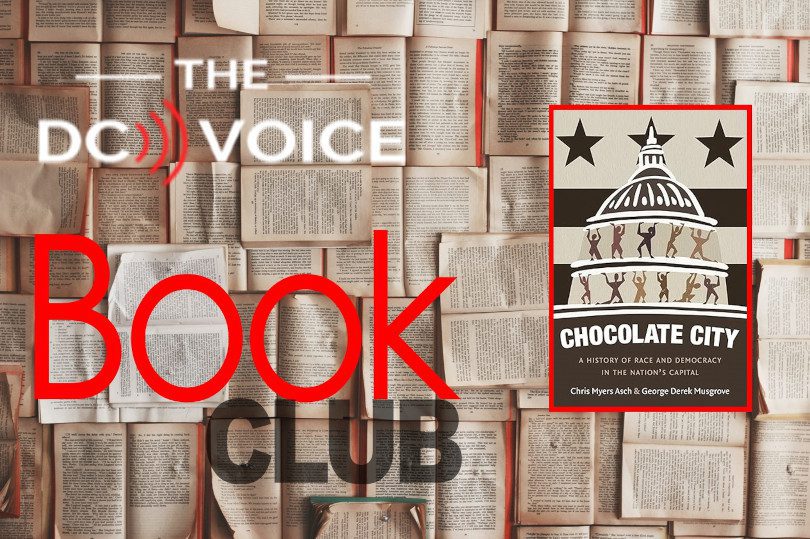
Chocolate City: A History of Race and Democracy in the Nation’s Capital by Chris Myers Asch and George Derek Musgrove is a detailed, decade-by-decade walk through of the history of changes in the area that would become the home of the nation’s capital: Washington, D.C. It tracks the evolution of the D.C. area from the settlers’ encounters with the Native Americans forward. Each decade, or century, is used as a marker in time of changes to the area, sometimes as if time itself is being repeated.
Chocolate City covers 234 of the nation’s 250-year history, as well as the 168 years prior to its independence. It presents D.C. in the context of its founding and the decision to make it the capital of the new nation instead of Philadelphia, based mainly on its geographical location to appeal to southern constituencies. The authors paint in broad historical strokes as well as neighborhood-by-neighborhood highlights that have shaped the city. It speaks of a whites-only neighborhood in LeDroit Park that used a wooden fence to prevent residents from Howard Town (a historically segregated, Black-only neighborhood located in Northwest D.C., bounded by Florida Avenue to the south and Howard University to the north) from walking through their community.
It covers everything from the city’s slave trading, Jim Crow, white flight, gentrification, and the re-entry of whites to the city. In short, it is one of the most comprehensive histories of D.C. that I have come across. The book tracks the cry for representation all the way back to the city’s founding. The irony of “taxation without representation” is not lost on the authors as the genesis of the Revolutionary War. That cry adorns D.C. license plates to this day.
If you’re looking for a deep history and accounting of Washington, D.C. – from its founding, seemingly intrinsic racial battles, rise of its Black population as the first majority-Black major city in America, to its gentrification to reduce that Black population, that provides the history from D.C.’s grand and strategic design to the struggles from a neighborhood-by-neighborhood perspective – this is a great read. At the very least, you will discover at least a dozen facts about D.C. you may not have been aware of, even if you are a native Washingtonian like me.