

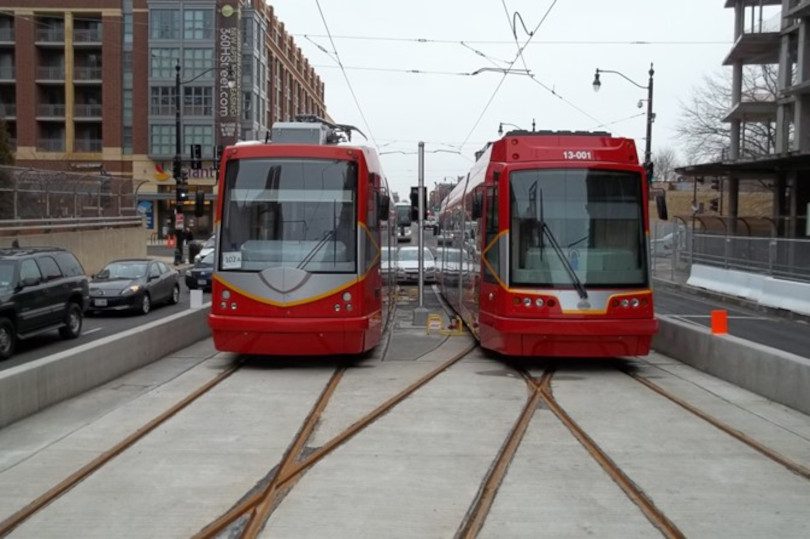
I fondly remember riding Washington’s streetcars with my mother, especially as they rolled past the Wonder Bread plant. Like many longtime Washingtonians, I welcomed the idea of bringing streetcars back to the District. What returned, however, was not a citywide transit network, but a disconnected three-mile line that never lived up to its promise. Yet with the Washington Commanders preparing to return to RFK Stadium, that same stretch of track linking Union Station and the Carver-Langston neighborhood could finally serve a meaningful transportation purpose. That’s why shutting down the streetcar system now makes no sense.
The Original DC Streetcars: 1862–1962
DC once had one of the most extensive streetcar systems in the United States. Beginning with horse-drawn cars in 1862 and later electrified lines, streetcars shaped much of the city’s growth. Neighborhoods such as Brookland, Petworth, Mount Pleasant, and Anacostia expanded along streetcar corridors, creating what planners still call “streetcar suburbs.” (Wikipedia)
By the early 20th century, nearly all local transit was consolidated under a few large operators, and streetcars became the backbone of daily transportation. But after World War II, rising automobile ownership, suburbanization, highway construction, and a policy shift favoring buses led to a steady decline. The final traditional streetcar ran in January 1962. (Wikipedia)
The Return of Streetcars
In the 1990s and early 2000s, planners concluded that Metro was excellent for commuting downtown but less useful for neighborhood-to-neighborhood trips. They envisioned a modern streetcar system that would connect commercial corridors, encourage development, and provide rail transit at a lower cost than Metro expansion. (Greater Greater Washington)
The original vision was ambitious: roughly 37–40 miles of streetcar lines across the city. H Street/Benning Road was intended to be just the first segment. (Wikipedia)
What actually happened?
The project suffered years of delays, management problems, and changing plans.
- Planning began in the early 2000s.
- Officials initially expected service around 2013.
- The H Street line finally opened in February 2016.
- Instead of a citywide network, DC ended up with a single 2.2-mile line from Union Station to the RFK area. (Wikipedia)
Many planned extensions—including long-promised connection to Benning Road Metro and routes east of the Anacostia River—were repeatedly delayed or never built. (Greater Greater Washington)
Why the Revival Failed
The system never became a network.
Several factors contributed to the failure. The line only ran about 2 miles. Riders could not use it to reach major destinations across the city, as originally hoped. And it never connected directly to enough transit hubs to generate high demand. Low ridership also plagued the streetcars. Even though rides were free, daily ridership remained modest. It suffered from poor design which placed it in direct competition with the regular traffic lanes. Cars, delivery trucks, crashes, and double-parked vehicles could block service.
Finally, the city spent roughly $200 million building the line and around $10–12 million annually to operate it. Extending the line to Benning Road Metro was estimated to cost roughly another $100 million. As budget pressures increased, support weakened. (The Washington Post)
The Final Straw or Greatest Opportunity?
In 2025, Mayor Muriel Bowser announced plans to replace the streetcar with electric buses. The city argued that buses could use existing electrical infrastructure while being cheaper, more flexible, and easier to expand. Funding was subsequently eliminated, and the DC Streetcar ceased operations on March 31, 2026. Although the plight seemed inevitable, it seemed that it was ceasing operations just when this isolated piece of track might be primed to experience its best opportunity to succeed – the return of the Washington Commanders.
Fast forward to the completion of the new Commanders stadium near the RFK site. Imagine tens of thousands of fans arriving from Maryland and Virginia by Metro, MARC, Amtrak, and eventually Virginia Railway Express connections through Union Station. What better way to showcase the H Street-Benning Road corridor than a streetcar carrying game-day crowds from Union Station through one of the city’s most vibrant commercial districts?
Instead of heading directly to the stadium and leaving immediately afterward, visitors could stop for dinner, drinks, or shopping along H Street, spreading spending among local businesses. Urban economists call this the “multiplier effect”—using transit to connect visitors with surrounding commercial districts rather than isolating spending inside a stadium complex. If even a small percentage of the more than 60,000 fans expected at Commanders games spent money along the corridor before or after events. The resulting sales tax revenue and business activity could offset a significant portion of the streetcars’ operating costs.
Consider also that the new Commanders stadium is projected to host not only NFL games but concerts, college sports, and other major events. The question is no longer whether enough people will be near the streetcar line. It’s whether the city is willing to abandon the infrastructure just as a major destination is about to emerge at one end of it. I cannot believe that somewhere in the corridors of the DC Office of Planning, people aren’t scratching their heads thinking “why now,” when we could have turned this blemish into a cash cow.
Our Missed Opportunity
Somebody has to have seen how cities like Kansas City, Portland, and Cincinnati leveraged their streetcars to revitalize downtown districts. These cities have demonstrated that streetcars can become catalysts for economic activity when connected to major destinations. Kansas City credits its streetcar with attracting development and businesses downtown. Portland’s Pearl District transformed from rail yards into one of the city’s most vibrant neighborhoods along its streetcar route. Even Cincinnati’s controversial streetcar survived years of political attacks before becoming part of its downtown revival.
The District spent two decades trying to justify a streetcar line that connected too few destinations. Now, just as one of the region’s largest entertainment venues is about to arrive on that route, the city has decided to abandon it. That isn’t just bad transit policy—it may be one of the worst-timed transportation decisions in recent memory.
Maybe it’s just me but somebody has to convince me why stopping the streetcars now makes sense!
Featured image/photo courtesy of Vox.
#DCStreetcars
#DCVoice
#TheDCVoice
#DCVoiceMedia
#DCVoiceNetwork
#DCVoiceTV
#DCVoiceStudios
#DCVoiceOfficial
#changingthenarrative
#media
#news