

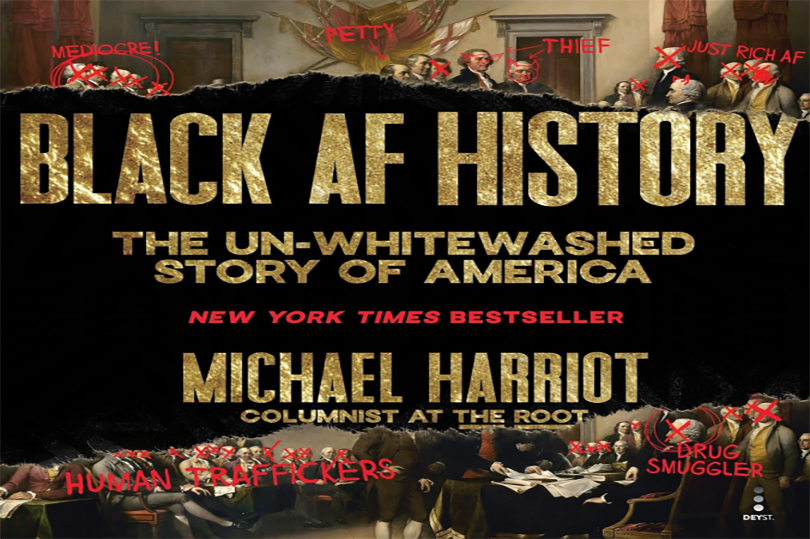
Michael Harriot’s Black AF History is a bold, irreverent, and deeply insightful reexamination of American history that blends scholarship with razor-sharp wit. Harriot doesn’t just retell history—he interrogates it, exposing the contradictions between America’s ideals and its actions. With humor that ranges from laugh-out-loud funny to quietly biting, he dismantles the myths that have long shaped the nation’s understanding of itself. Beneath the satire lies a serious and urgent critique: a country that repeatedly avoids confronting systemic injustice by shifting blame onto Black people instead of addressing its own failures.
 What sets Harriot apart is not just his voice—immediate, conversational, and unapologetically Black—but also his structure. Each chapter is paired with questions and supplemental material that challenge readers to go beyond passive consumption. This isn’t history as something to memorize; it’s history as something to wrestle with. The questions act as a kind of intellectual provocation, pushing readers to interrogate what they’ve been taught and to recognize the gaps, distortions, and outright omissions in traditional narratives. It’s a unique and effective approach that reinforces the book’s larger mission: not just to change the narrative, but to teach readers how to question who controls it.
Chapter 11, “So Devilish a Fire,” stands out for its unflinching look at backlash and resistance, but more importantly for how it elevates the enduring role of Black women as truth-tellers—particularly through the legacy of Ida B. Wells. Harriot uses Wells as a throughline to illustrate how confronting America’s violence has always required someone willing to name it plainly. As a pioneering journalist and anti-lynching crusader, Wells did more than document atrocities—she exposed the lies used to justify them, dismantling the mythologies that allowed racial terror to persist.
Through Wells, Harriot underscores a central contradiction: that America has long depended on distorted narratives to maintain its moral self-image, even in the face of undeniable brutality. Wells’ work directly challenged that distortion, forcing the country to reckon with truths it preferred to ignore. In this way, she represents the very essence of what Harriot is doing in Black AF History—rewriting the narrative by insisting on accuracy, accountability, and clarity.
Harriot also situates this struggle within a broader structural context, pointing to policies like the New Deal and the GI Bill, which helped build the American middle class while disproportionately excluding Black people through discriminatory implementation. By the time later movements for civil rights gained traction, white Americans had already received a significant economic head start. This context makes clear that the backlash against Black progress was not just ideological—it was deeply tied to preserving economic advantage.
The chapter’s closing “Homework” section is especially powerful, distilling Harriot’s argument into something unflinching and direct. It reads less like an academic exercise and more like a challenge—a call for readers to confront the narratives they’ve inherited and to recognize how those narratives continue to shape the present. In many ways, if you read that final section alone, you would grasp the essence of the entire book: unyielding, incisive, and unwilling to let the reader off the hook.
Ultimately, Black AF History is more than a retelling—it is a reclamation and a reckoning. By pairing sharp storytelling with reflective questions, elevating figures like Ida B. Wells, and exposing the structural inequalities embedded in landmark policies, Harriot not only changes the narrative, he teaches readers how to write their own. And in doing so, he leaves us with a clear and urgent truth: when America confronts its contradictions, it has too often chosen to “fix Black people” instead of fixing itself.
#BlackAFHistory
#DCVoice
#TheDCVoice
#DCVoiceMedia
#DCVoiceNetwork
#DCVoiceTV
#DCVoiceStudios
#DCVoiceOfficial
#changingthenarrative
#media
#news