
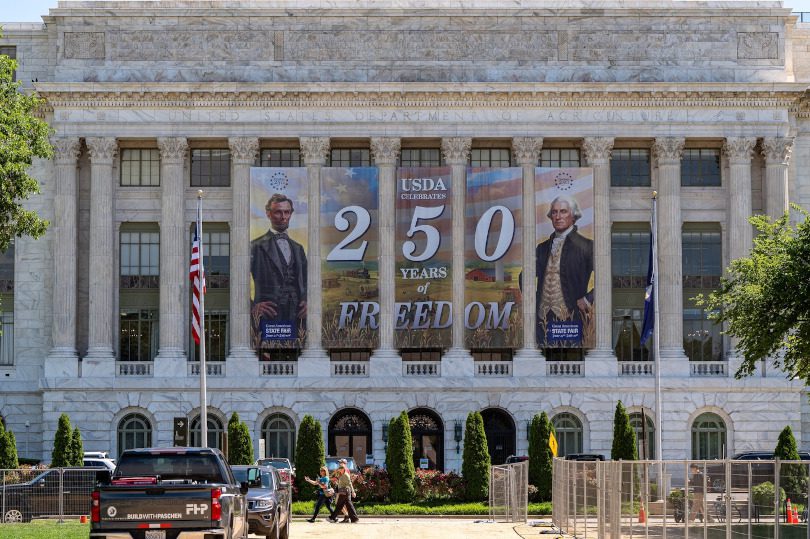
This July 4th, fireworks erupted over the National Mall as Americans gathered to celebrate 250 years since the signing of the Declaration of Independence. The marble monuments glowed beneath red, white, and blue lights. Tourists stood before the Capitol, the White House, and the Supreme Court, institutions that have become global symbols of representative government.
But for more than 700,000 people who call Washington, D.C. home, those symbols stop short of reality.
Lack of Representation
Washington, D.C. residents pay federal taxes, serve in the military, and fulfill the same civic responsibilities as other Americans. Yet they have no voting senators and only one delegate in the House of Representatives. That delegate can participate in committee work but cannot cast a final vote on legislation. Congress also maintains authority over many aspects of the District’s local government. This gives lawmakers from other states influence over decisions that directly affect D.C. residents.
Two hundred and fifty years after a revolution fought against taxation without representation, that principle remains unresolved in the very city built to embody it. As America commemorates its semi quincentennial, the question has evolved beyond what the nation’s founding ideals were. It is what those ideals mean in the democratic capital where residents continue to live without full representation on the national stage.
For some residents, America’s 250th anniversary is both a celebration and a reminder of promises left unfulfilled. “I think it’s very disappointing that we are celebrating 250 years in our own capital and we do not have a single senator representing us,” said Mia Mathus, a relatively new D.C. resident, in a July 2 interview. “We pay our taxes, we represent our country and we deserve to have more of a say.”
Mathus’s frustration reflects a broader debate that has lingered over Washington for decades. Supporters of D.C. statehood argue that residents deserve the same representation afforded to every other American citizen. Opponents contend that the Constitution established a federal district separate from the states for a reason. They argue that changes should come through other legislative solutions.
Washington’s Unique Status
Georgetown Law student Liam Harper explained that Washington’s unique status traces back to concerns held by the nation’s founders. The Framers created a separate federal district intended to remain politically independent from any one state.
“When they built the United States, they were worried about favoritism,” explained Harper in a July 3 statement to the DC Voice. “They thought that if the capital city was located inside a regular state, like Pennsylvania or New York, that state might get special treatment. That state might also have too much power over the president and the national government. To prevent this, the Founders wanted the capital to belong to everyone and no one at the same time. They made it a separate ‘neutral zone’ that didn’t belong to any state.”
While the reasoning behind the federal district has remained largely unchanged, Washington itself has. Today, the District is home to more than 700,000 residents, more people than the states of Wyoming and Vermont. As the nation marked this huge milestone, Washington became the center of patriotic celebrations. The streets filled with parades, concerts, and fireworks honoring the ideals of liberty and representative government.
But for many Washingtonians, the anniversary is also an invitation to ask a difficult question: What does it mean to celebrate American democracy in the one place where hundreds of thousands of American citizens still cannot fully participate in it?
Two hundred and fifty years after the Declaration of Independence proclaimed that governments derive “their just powers from the consent of the governed,” that question remains unanswered for the people who call the nation’s capital home.
Featured image/photo by Alex Brandon/AP.
#250YearsLater
#DCVoice
#TheDCVoice
#DCVoiceMedia
#DCVoiceNetwork
#DCVoiceTV
#DCVoiceStudios
#DCVoiceOfficial
#changingthenarrative
#media
#news