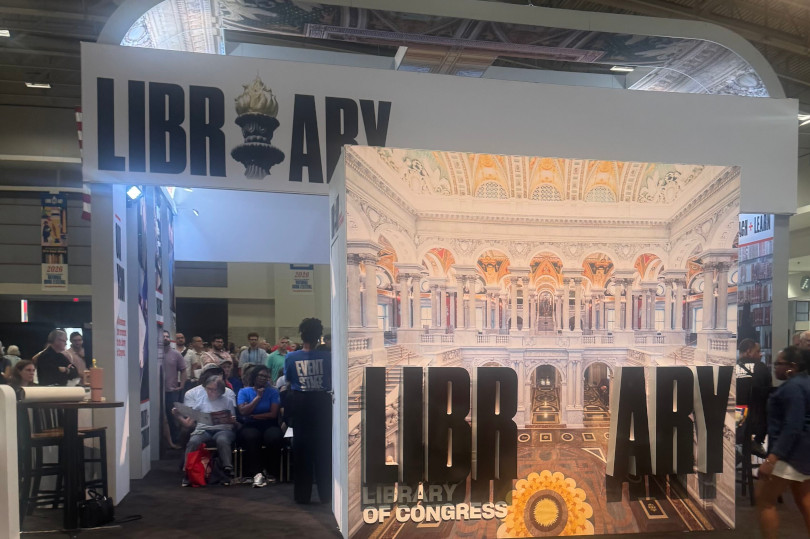
On Saturday, August 22 hundreds of DC residents, tourists, families, and book fans crowded the downtown streets of the nation’s capital for the 2026 National Book Festival. Hosted annually by the Library of Congress, this literary event brings together several bestselling authors and offers activities such as panel discussions, talks, and book signings. This year’s festival took place at the Walter E. Washington Convention Center from 9 a.m. to 8 p.m. and was free to the public with ticket purchase. Over 80,000 people registered for the event this year.
Acting Librarian of Congress Robert Newlen began the opening ceremony, celebrating the Library of Congress’s 26th year hosting the book festival. The event also reflected on Newlen being its longest-serving acting librarian as well as this year’s theme, America 250. “The theme of this year’s festival is, appropriately, ‘America 250: It’s Your Story,’” said Newlen. “The festival is, of course, a celebration of authors and readers, but it is something even bigger. It is a celebration of ideas, imagination, and the people who keep a democratic culture intellectually alive. The National Book Festival remains the preeminent literary event in the nation.”
Newlen then discussed the festival’s unique ability to bring together some of the most compelling writers and thinkers of the century and its importance for inspiring a generation of readers
“For someone who has always dreamed of writing, hearing a writer describe the creative process can be life changing, and for all of us, listening to an author talk about a book can deepen our understanding of the world, and sometimes even change the way we see it,” he said. “This is the magic of the National Book Festival – it creates a rare space in our increasingly distracted world, where we can slow down, listen carefully, and engage with ideas.”
Across different floors, the event featured a diverse array of key speakers and visionaries, including Max Brooks, Jordan Moblo, Davia Nelson, Martin Scorsese, Nikki Silva, Sasha Waters, and Artemis II commander Reid Wiseman, who discussed his experience leading the first crewed Artemis flight. Several individuals served in dual roles as both authors and speakers, such as Cynthia Erivo and Michael Feinstein. The programming also highlighted dynamic conversations between notable figures, including actress Kate McKinnon, who discussed her “mad science” series with Amna Nawaz, and award-winning historians Douglas Brinkley and Annette Gordon-Reed, who joined moderator David M. Rubenstein to examine American pride and resilience.
Other significant contributors who shared their expertise and personal narratives included legendary comic book writer Frank Miller, who spoke on his unconventional artistry, and journalist Geoff Bennett, who explored the history of Black American comedy in a session moderated by Frederick F. Wherry.
I found my way out of the crowded auditoriums and checked out the exhibits that were equally crowded. Organizations lined up to display their manuscripts, archives, books and audio for guests to ponder. This year’s America 250 theme was pretty obvious, with red, white, and blue displays and DC merchandise.
Nonetheless, I mainly enjoyed learning about the role of libraries such as the Library of Congress in archiving much of our information. But in the moments, I quietly scanned through piles of scriptures and artifacts and watched how engaged my fellow attendees were with the activities, I couldn’t help but think broadly about the current landscape of literacy. The defunding of many public libraries and schools, caps on access to higher education, book-banning efforts, and rising concerns about AI replacing original work all challenge the freedom and democratization of the very information presented in front of me that seeks to shape our generation of thinkers.
Meanwhile, archives such as the Internet Archive and Wayback Machine, museums like the Smithsonian, and libraries like the Library of Congress – these are all examples of places that have dedicated themselves to preserving knowledge and artifacts and making them accessible for researchers and the public. They are our modern-day Library of Alexandria, a window into the voices and cultures of communities before us.
Consequently, reading for pleasure can be a way to understand yourself and the world around you when other opportunities or resources are actively limited. And maybe that’s what I found most rewarding about observing this past Saturday: that in a world of ongoing limitations on literacy, the passion for reading and engaging with information at large among the public will not be going away any time soon.
Featured image/photo by Nirali Patel.
#NationalBookFestival
#DCVoice
#TheDCVoice
#DCVoiceMedia
#DCVoiceNetwork
#DCVoiceTV
#DCVoiceStudios
#DCVoiceOfficial
#changingthenarrative
#media
#news