

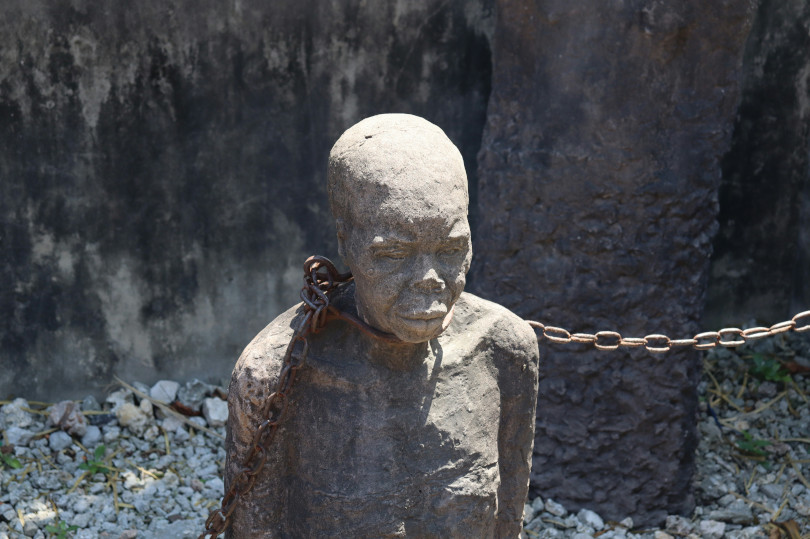
I’ve struggled recently with the question of why African chiefs or leaders allowed the transatlantic slave trade to continue if they knew how horrific the conditions were that their people were being cast into. I figured the word had to have reached them at some point and they would have decided not to participate. Regardless of tribal affiliation, I reasoned that there had to be a sense of humanity and resistance to white interlopers treating humans like property. The fact that there were Africans trading slaves had to be the ultimate betrayal.
I came across a number of sources that helped shed light on this question led by African Voices of the Atlantic Slave Trade – Beyond the Silence and the Shame by Anne C. Bailey. This post delves into a number of factors that influenced Africans trading slaves, starting with domestic slavery.
Domestic slavery was a vehicle to build political, economic, and military power by using captives from warfare, indebtedness, and judicial punishment to work on plantations and serve in royal households. A chief’s power and influence were measured by the number of slaves he possessed. Bailey writes, “…slaves were vital not only to the maintenance of the political realm but to the economy, the military, traditional religious groups, and other social institutions. Domestic slavery also was not considered a permanent state.” Bailey goes on to write, “African slavery was much more varied [than chattel slavery] and sometimes included ways in which slaves could rise above their station and even become chiefs.” A slave could even become a part of the tribe or be “adopted” by the family. Chattel slavery, on the other hand, is a form of human bondage where enslaved individuals are legally defined as personal property rather than people. So, did they see transatlantic slavery as simply an extension of domestic slavery?
Another potential answer suggested by Bailey and other authors is that a great number of slaves weren’t sold but kidnapped. Contrary to our belief that Africa saw itself as a continent of people bound by color, Africans saw themselves as independent countries or tribes. The vastness of the continent created numerous smaller isolated tribes that lived separate from the larger tribes. So, the idea of huge tribes, connected by powerful chieftains uniting a continent is not accurate. This tribal disparity allowed for Europeans to plunder tribes for slaves at will. There are various accounts of slaves being lured onto slave ships through trickery, silks, and other means. The incident at Atorkor speaks of hundreds of Africans lured onto a slave ship by European slave traders under pretense of friendship and celebration. What’s ironic about Atorkor is that the chief was more offended that these slaves were stolen from his coastal tribe and not the tribes from the inner continent. It sounds a lot like “the suburbs” versus “the inner city.”
A third reason proffered has to deal with the overwhelming organization and power of the European/American slave operation. In the chapter on European and American Agency, Bailey identifies six pillars of the Atlantic slave trade: (1) demand, (2) organization, (3) trading activities on the African coast, (4) the Middle Passage voyage, (5) trading in the Caribbean, and (6) industrialization in Europe. Controlling five of these six is Europe/America. Bailey writes that Christopher Columbus’ voyage to the Caribbean transformed African/European trading from gold, pepper and other spices into the demand for human labor to exploit the treasures of this newly “discovered” Caribbean. The chapter emphasizes how the European/American cunning, military might and greed were no match for the African tribes. I’ll leave it to you to explore these claims on your own.
With three contributing factors to my original question of why, I still felt lacking a clear answer. As with most complicated questions, there is rarely a simple answer. I surmise that there was a convergence of issues. Africans grasped the fundamental difference between the domestic slavery they had practiced for centuries and the new-found chattel slavery of the European/Americans but found themselves unable and in some instances unwilling to forgo the profits of trades. Massive kidnappings of Africans were reported but not enough to account for 12.5 million slaves! Finally, African empires like the Dahomey Kingdom, Ashanti Empire, Oyo Empire, and the Imbangala probably account for a great number of these slaves as their conquering might within Africa made it easy for them to acquire tens of thousands of slaves at a time.
So, was it a betrayal? In my humble opinion, yes, when it comes to the millions that were sold in exchange for European goods and trinkets, knowing the fate these slaves were about to suffer in the chattel slave system. They knew by the accounts of freed slaves such as Olaudah Equiano and European slave traders themselves. The lure of prestige and European guns and liquor were their prevailing reasons. This wholesale depletion of males from Africa led directly to its ability to be easily colonized by the same European interlopers. Although kidnapping and European/American force played a part, profit, prestige and power was the ultimate goal for all participants.
Other resources to consider:
The Transatlantic Slave Trade by Melvin King
The Slave Trade in Africa – Charles River Editors