

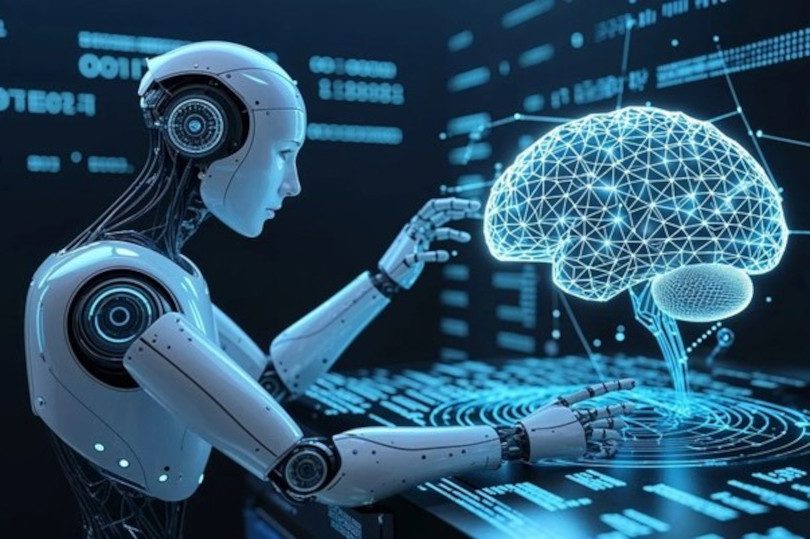
Each generation has dealt with technological advances at what they would have considered an accelerated pace. The Greatest Generation went from horse and buggy to ushering in the Atomic Age. Baby Boomers went from rotary dial phones to commercial space travel. These technological changes created a level of hysteria about how they were going to destroy the human race. Despite dire warnings of mass destruction and society crumbling beneath us, so far (fingers and toes crossed) we’ve survived. Artificial Intelligence will be no exception.
Past Predictions
Consider the predictions below regarding the atomic bomb. All were prominent and renowned scientists of their time.
Norman Cousins — “Modern Man Is Obsolete” (1945). “The problem is no longer whether man can survive, but whether civilization can survive.”
Bertrand Russell — “The Atomic Bomb” (1945). “The prospect for the human race is sombre beyond all precedent…. A great deal of new political thinking will be necessary if utter disaster is to be averted.”
Albert Einstein (1946) — “The unleashed power of the atom has changed everything save our modes of thinking, and we thus drift toward unparalleled catastrophe.”
Although we continue to live under the fear of nuclear proliferation, the same technology that gave us the atomic bomb has also given us advancements in electricity, disease treatments, and other scientific breakthroughs. It even filters down to day-to-day conveniences we take for granted, such as cancer detection and treatment. Millions of people have benefited from nuclear medicine, such as radiation therapy for cancer and medical imaging using radioactive tracers. Even smoke detectors, a household safety requirement, contain Americium-241, a radioactive material produced in nuclear reactors. Our food safety and preservation rely on nuclear irradiation to kill bacteria, parasites, and insects in food. The recurring theme will be that there is no way to predict the outcomes of nascent technologies.
The Computer Age
The Greatest Generation passed the baton to Baby Boomers, who ushered in the computer age. It reduced room-sized mainframe computer rooms to a hand-held mobile device with significantly more power. This was catapulted by integrated circuits commonly referred to as “chips.” Along with this new technology came a new set of detractors. One of those detractors was none other than a future President of the United States. John F. Kennedy warned of mass unemployment from automation (1960): “This is a revolution bright with the hope of a new prosperity … but it is also a revolution which carries the dark menace of industrial dislocation, increasing unemployment, and deepening poverty.”
Other detractors warned that “computers and automation would eliminate jobs faster than new ones could be created… Society would need guaranteed incomes because humans would become economically obsolete.” Yet, like its nuclear predecessor, the computer age has had a profound impact on society. It created entirely new industries and millions of jobs. It revolutionized medicine, connected the world physically and virtually, and expanded overall access to information and innovation.
Much like its nuclear counterpart, the computer age has seamlessly infiltrated our daily routines. Consider GPS and navigation, which many of us rely on now instead of maps. Most people think of GPS as a satellite technology, but it depends on powerful computers processing signals from multiple satellites in real time. When was the last time you used an ATM or some form of electronic banking? Without the computer age, online banking, debit card purchases, direct deposit, and other mobile payment apps would be non-existent. Even the accuracy of weather forecasting is greatly enhanced through the use of supercomputers processing enormous amounts of atmospheric data.
Here Comes Artificial Intelligence
Post Boomers, a collective name for all of the generations following Baby Boomers, will pick up the mantle for artificial intelligence. Despite the current hyper-focus on AI and the rousing chorus of doom and gloom, its creation can be mapped back to 1956. The field of AI research was founded at a workshop held on the campus of Dartmouth College. However, even that was preceded by Alan Turing (“The Father of AI”), who published Computing Machinery and Intelligence, posing the question “Can machines think?” in 1950.
The explosive growth of artificial intelligence has been fueled by the convergence of massively increased computational power and the availability of massive “big data” sets across the Internet. Breakthroughs in algorithmic architecture (specifically, generative models and neural networks) that allow systems to learn from data are fueling the current rage. AI has no less prominent detractors than nuclear or computer technologies, as evidenced below.
Geoffrey Hinton, a British-Canadian computer scientist and Nobel Prize laureate for his work on artificial neural networks, which earned him the title “The Godfather of AI,” has issued several warnings on the topic. In the Forbes article “Geoffrey Hinton Predicts Human Extinction At The Hands Of AI. Here’s How To Stop It,” he warns of a “10% to 20% chance that AI could drive humanity to extinction within 30 years.” There are also growing environmental concerns regarding the massive water and power drains of AI data centers.
Part of Our Daily Lives
The National Wildlife Federation writes that “as the use of AI proliferates, environmental policy analysts, academic researchers and others are raising concerns about the impacts the data centers powering the technology are having on communities, ecosystems, and the climate. Among those concerns are the immense energy and water resources the centers require and the air, light, noise, and other pollution they generate. Recent reporting and research have pointed out some of the dangers, from diminished water supplies in regions already facing shortages to potential health risks from air pollutants.”
Much like its predecessors, AI has already crept into our daily routines and plays a major role. Navigation and traffic routing (Google Maps, Waze, etc.) use AI to analyze traffic patterns, accidents, road closures and driver behavior to determine the fastest route. Fraud detection in banking and credit cards is another example of AI at work. Every time you use a credit card, AI systems are working behind the scenes to detect suspicious activity. Even that call to voice assistants (Siri, Alexa, Google Assistant) is AI at work.
The Lesson of History
So, given this brief stroll through history, it’s too soon to know the impact artificial intelligence will ultimately have. As we can see, from harnessing the atom to perfecting the computer, there are pros and cons with each technological advance. AI may prove to be one of the most transformative technologies in human history. Like the atom and the computer before it, it carries both extraordinary promise and legitimate risks that should not be ignored. The lesson of history is not that technological fears are always wrong or should be relegated to naysayers. Nuclear weapons remain dangerous, computers have displaced jobs, and the Internet has created new social challenges. The real lesson is that technology itself is rarely the ultimate threat.
The atom did not decide to build a bomb. Computers did not choose how they would be used. The Internet did not invent misinformation. Humans did. If civilization faces danger from artificial intelligence, it will not be because machines suddenly decide to destroy us. It will be because we fail to use wisdom, restraint, and responsibility in guiding the tools we create. AI isn’t going to destroy the world… humans might.
Featured image/photo by Carlos Olmos from Pixabay.
#AIisn’tgoingtodestroytheworld
#DCVoice
#TheDCVoice
#DCVoiceMedia
#DCVoiceNetwork
#DCVoiceTV
#DCVoiceStudios
#DCVoiceOfficial
#changingthenarrative
#media
#news