
Washington called it a victory. Six months later, Venezuela is unstable, Cuba is in a humanitarian crisis, Iran is devastated, and American credibility is in freefall. Is this what winning looks like?
Since Nicolás Maduro’s capture on January 3rd, Venezuela has reached a seven-year high of oil exports, adding up to an estimated $8 billion. Cuba‘s economy is spiraling in part because of its reliance on subsidized oil from Venezuela, which has stopped after Maduro’s removal. In April, Venezuelan lawmakers passed a new mineral law establishing a more concrete framework to incentivize investments. The US and Venezuelan governments conducted a joint operation killing Tren de Aragua leader Niño Guerrero. On June 16th, Venezuela’s interim president Delcy Rodriguez signed an agreement with US energy giant General Electric to rebuild the country’s electricity grid. On July 15th, the interim government announced it would hold talks with members of the opposition starting in August. All of which are points in support of the opinion that the removal of Maduro has been a success. But what has materially changed in Venezuela?
On the ground in Venezuela, the picture is bleak. As of May 25th, over 400 political prisoners remain detained. Oil production has surged, but the revenue has not reached ordinary Venezuelans. Inflation is rising, the currency is devaluing, and a growing perception inside Venezuela is that the United States is there for the oil, not the people.
Politically, Venezuela is adrift. The opposition has lost coherence, largely due to Trump’s public marginalization of Maria Corina Machado, who, despite this, still commands majority support among Venezuelans. However, Machado still is unable to return to the country. And the opposition group that will be coordinating with the interim government is former lawmakers from the 2015 national assembly. This was the last time the opposition won the majority of the legislative body. This opposition group will be led by Dinorah Figuera, who returned to Venezuela on invitation from the State Department with the goal of strengthening the electoral system and democratic institutions. Meanwhile, Chavismo is fracturing internally, with historic PSUV figures like Elías Jaua mobilizing activists against U.S. involvement and the interim government led by Delcy Rodriguez.
What is absent from all sides is any coherent, transparent roadmap to free and fair elections. The aftermath of the two earthquakes that shook Venezuela on June 24th is a death toll of over 3,500, close to 17,000 people injured, and almost 18,000 left homeless, and widespread panic, uncertainty, and instability, which is only growing.
The first domino to fall was Cuba. With Venezuelan subsidized oil cut off and a U.S. blockade now in place, Cuba is experiencing a wartime-scale economic crisis, one compounded by decades of governmental mismanagement. The consequences are not abstract: blackouts, food spoilage, hospitals postponing surgeries, and deaths. Washington frames this as pressure toward a more liberalized economy with greater private-sector investment. On the ground, it looks like a humanitarian emergency. More urgently, the hot Cuban summer makes the Florida Straits maximally navigable, and the United States is unprepared for the migration crisis that this level of desperation could unleash.
The second domino was larger and more dangerous. The Venezuela operation didn’t just remove Maduro; it taught the Trump administration that military force works. That lesson traveled quickly to the Middle East. Trump applied the same playbook to Iran: strike first, then negotiate with whoever remains. But Iran is not Venezuela. The scale of destruction, thousands dead, homes, schools, and hospitals reduced to rubble, reflects what happens when tactical military confidence outruns strategic thinking. A memorandum of understanding signed on June 17th has been presented as a win. It is not a plan. There is no transparent framework for what denuclearization looks like. There is no defined process for political transition, and no stated view of what the future should look like. The Venezuela playbook, exported to Iran, has produced not resolution but devastation and a precipitous collapse of American credibility worldwide.
Six months after Maduro’s removal, what actually happened was a steady erosion of American diplomatic credibility. Blunt-force tactics delivered the appearance of victory — oil exports up, a memorandum signed, a warlord killed. But in Venezuela, political prisoners remain behind bars, and elections have no roadmap. In Cuba, people are dying in the dark. In Iran, the rubble is still smoldering. The only thing the United States has successfully exported across all three is instability. Trust in American leadership at home and abroad does not recover on its own. Right now, very little in Washington suggests anyone is trying to rebuild it.
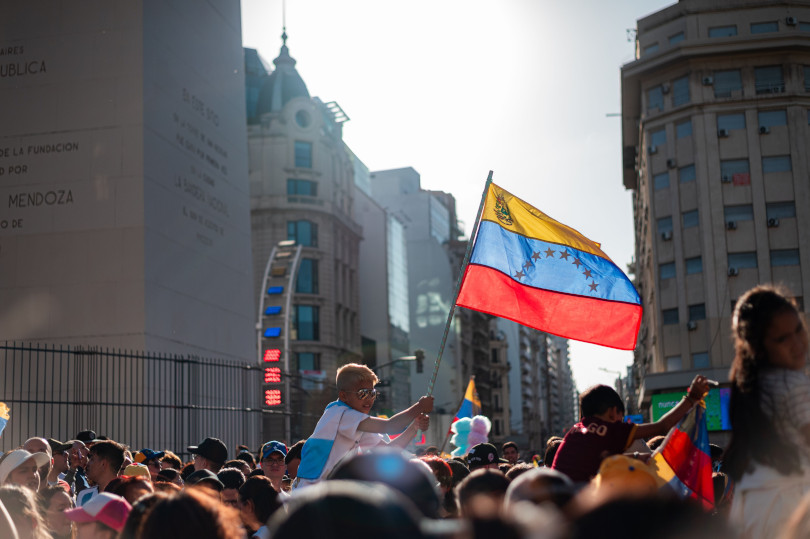
Featured image/photo by Alex Dos Santos on Pexels.
#SixMonthsAfterMaduro
#DCVoice
#TheDCVoice
#DCVoiceMedia
#DCVoiceNetwork
#DCVoiceTV
#DCVoiceStudios
#DCVoiceOfficial
#changingthenarrative
#media
#news