
September is National Sickle Cell Awareness Month, designated by Congress to help focus attention on the need for research and treatment of sickle cell disease.
Sickle cell disease (SCD) affects about 100,000 people in the United States; more than 90% are non-Hispanic Black or African American, and an estimated 3%–9% are Hispanic or Latino. The estimated life expectancy of those with SCD in the United States is more than 20 years shorter than the average expected.
I remember as a child in the 60s, hearing about sickle cell and someone coming to our house to screen the family, aimed at identifying SCD. These efforts were often research-driven and targeted specific populations, shaped in part by advocacy from African American communities. Public awareness campaigns during this time highlighted the need for education about the disease and its implications.
What is Sickle Cell?
Sickle cell is a rare genetic disease, but it’s not uncommon. The disease, or the trait, can affect anyone. While many people with sickle cell are Black, it’s also prevalent in people who live in or can trace their roots back to the Middle East, Mediterranean, Central America, and South America.
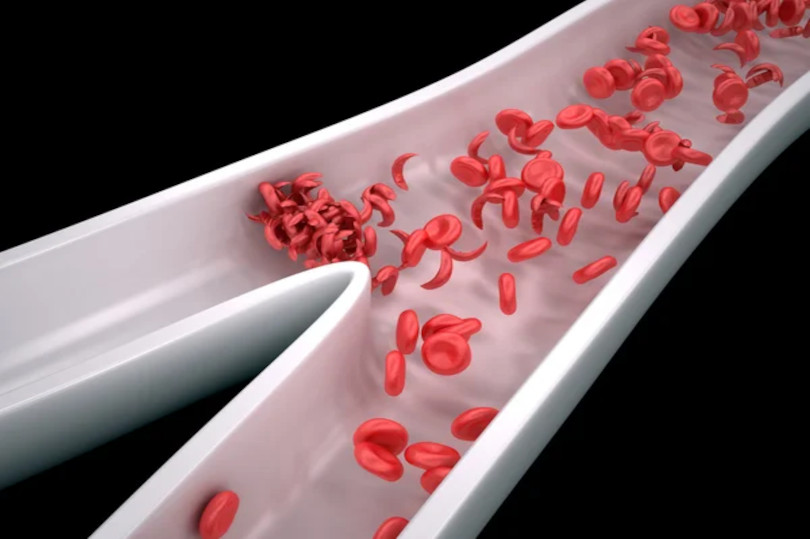
Sickle Cell Anemia is one of the most common inherited disorders in the United States. It affects the shape of red blood cells, which carry oxygen to all parts of the body.
Red blood cells are usually round and flexible, so they move easily through blood vessels. In sickle cell anemia, some red blood cells take on crescent-moon or sickle shape. These sickle cells also become rigid and sticky, which can slow or block blood flow.
Sickle Cell Trait
Normally, a person inherits two copies of the gene that produces beta-globin, a protein needed to produce normal hemoglobin (hemoglobin A, genotype AA). Sickle cell trait is an inherited (genetic) condition that affects some of the hemoglobin in the blood. Hemoglobin is a part of your red blood cells, which carry oxygen in your body. In sickle cell trait, some of the body’s normal hemoglobin is replaced with hemoglobin S, also called sickle hemoglobin.
In cases where both parents have the sickle cell trait, it can result in their child being born with sickle cell disease.
Factors that put your baby at an increased risk for SCD include:
- Both parents are carriers of the sickle cell gene
- Family history of sickle cell disease
- African American, Mediterranean, or Middle Eastern ethnicity
Symptoms of Sickle Cell
Symptoms of sickle cell anemia usually appear around 6 months of age. They vary from person to person and may change over time. Symptoms can include:
- Anemia
- Episodes of pain called Crisis
- Swelling of hands and feet
- Frequent infections
- Delayed growth or puberty
- Vision problems
The current approach to treatment is to relieve pain and help prevent complications of the disease. However, newer treatments may cure people of the disease.
Too many people with SCD do not receive the recommended healthcare screenings and treatments. According to Data and Statistics on Sickle Cell Disease, despite their extensive healthcare needs, many persons with SCD have difficulty accessing appropriate care and report feeling stigmatized and having their symptoms dismissed when they do seek care.
SCD in Washington, D.C. (2025): Why No Exact D.C. Number Yet?
Sickle cell disease affects many people worldwide, and our nation’s capital is not exempt. However, Data and Statistics on Sickle Cell Disease reports there is no official 2025 published figure for the exact number of people with SCD living in Washington, D.C.
The SCDC program is actively collecting state-level data for D.C. from multiple sources, including newborn screening and healthcare records, but it releases state-level results only after it completes data collection and analysis for that jurisdiction. For D.C., this process is ongoing, so no confirmed 2025 count is available. The CDC’s Demographics and Healthcare Utilization Data page will post D.C. results when available.
Note that in May 2025, Mayor Bowser presented the Fiscal Year 2026 Budget: Grow DC, which includes $2.2 million to cover sickle cell anemia care and treatment.
Although specific sickle cell disease prevalence in D.C. is not yet available, Howard University Hospital offers an outpatient clinic for adults and children with sickle cell disease.
Adult Sickle Cell Disease Services
The Center for Sickle Cell Disease offers a weekly outpatient clinic for adults with sickle cell disease. The clinic is held each Monday from 8:00 AM to 12:00 Noon and each Wednesday from 1:00 PM to 5:00 PM in Suite B on the First Floor of the Howard University Hospital, 2041 Georgia Avenue, NW, Washington, DC 20060.
For further information about this clinic, call the nurse coordinator, Darwin Dollan, at (202) 437-7105.
Appointments for this clinic can be made by calling (202) 865-4700. During clinic hours, questions can be directed to (202) 865-1376.
Pediatric Sickle Cell Disease Services
Howard University Hospital has an ongoing collaboration with the District of Columbia Greater Access to Pediatric Sickle Cell Services Project, which is managed by Sohail R. Rana, MD, Professor of Pediatrics and Child Health, College of Medicine.
Children with sickle cell disease are seen three days a week. Call (202) 865-4583 for further information.
For more information about sickle cell trait and expanded hemoglobin mutation screening, visit: https://www.dchealthcheck.net/trainings/labs/sickle.html
FYI: Some Famous People with Sickle Cell Disease or Trait
- Tionne “T-Boz” Watkins – Singer, R&B group TLC
- Miles Davis – Jazz Icon/Musician
- Albert “Prodigy” Johnson – Rapper, Hip Hop group Mobb Deep.
- Tiki Barber – former NFL Player
- Moses “Beenie Man” Antony Davis – Jamaican dancehall DJ
- Billy Garrett Jr. – Former NBA Player
- Ryan Clark – Former NFL Player
- Jourdan Dunn – British Supermodel
- King Tutankhamen – Damage found in his body was likely caused by sickle cell disease
- George Floyd was discovered to have sickle cell trait after his death in police custody.
Screening for the Sickle Cell Disease trait is available at Howard University Hospital in Freedman’s Hall on the first Thursday of each month.
Featured image/photo courtesy of DepositPhotos.
#NationalSickleCellAwarenessMonth
#DCVoice
#TheDCVoice
#DCVoiceMedia
#DCVoiceNetwork
#DCVoiceTV
#DCVoiceStudios
#DCVoiceOfficial
#changingthenarrative
#media
#news